The distinction between the right hand and the left hand in the application of henna is not merely an aesthetic choice. It is rooted in religious codifications, social conventions, and, more recently, in visual staging logics that vary according to cultural areas and ritual contexts.
Right Hand and Spiritual Commitment: A Little-Documented Codification
In some contemporary Indo-Pakistani Sufi traditions, applying henna exclusively on the right hand during the bayʿa (spiritual pact) signifies a commitment to the inner path. The right hand is seen as the “giving hand,” associated with voluntary action and the connection to the spiritual master.
This distinction is not anecdotal. It extends a symbolic hierarchy present in fiqh and Islamic ritual practices, where the right hand is associated with purity, greetings, and the act of eating. The left hand, on the other hand, carries a connotation of interiority, of what is hidden or removed from social gaze.
We observe that this spiritual reading remains confined to specific initiatory circles. Understanding it helps avoid shortcuts that reduce the meaning of henna on the hand to a mere decorative question.
Henna and Fiqh: The Question of Visible Ornamentation
Recent Islamic legal opinions remind us that hands decorated with henna can be considered as a ornament to be concealed from foreign men. This point has a direct impact on the choice of the decorated hand.
The right hand, used for greetings and social interactions, is by nature more exposed. In contexts where dress modesty is strictly observed, applying henna on the left hand, less visible in public, becomes a compromise between aesthetics and religious conformity.
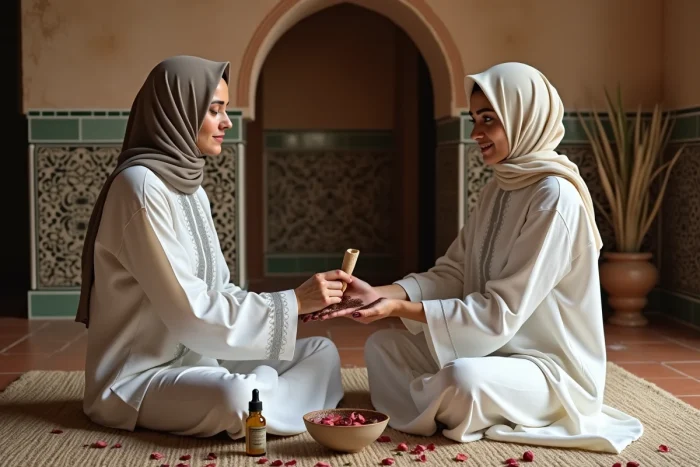
This normative framework does not apply uniformly. It varies according to legal schools, regions, and the degree of individual practice. However, it explains why some women wear elaborate patterns on the left and a discreet design (or none) on the right, where an outside observer might see only an aesthetic whim.
Social Hand, Intimate Hand: The Contemporary Distinction in the Maghreb
Henna practices in beauty salons in the Maghreb and the Middle East have given rise to a new interpretation in recent years, disconnected from the strict religious framework. The right hand has become the “social hand”, the one that appears in wedding photos, social media posts, and formal greetings.
The left hand, on the other hand, receives simpler or more minimalist patterns, intended for the private sphere. This distribution responds to a visual staging logic specific to beauty influencers and wedding photographers.
- Right hand: complex and detailed patterns, designed to be photographed from the front during the greeting gesture or the classic “hand on heart” pose
- Left hand: more streamlined designs, sometimes limited to the fingers or wrist, visible mainly in the intimacy of the home or during moments among women
- Some brides choose a deliberately asymmetrical program, with two distinct styles on each hand, to mark the duality between public life and married life
This distinction in usage, discussed in interviews and reports on contemporary Muslim beauty practices, does not appear in general popular articles. Yet it constitutes the main decision factor in specialized salons today.
Wedding Henna: Right for the Bride, Left for the Groom
In the wedding ritual, the distribution between the hands follows precise codes that vary by region. In Morocco, tradition dictates that the bride receives henna on both hands and both feet during the dedicated evening. The right hand is applied first, giving it symbolic preeminence.
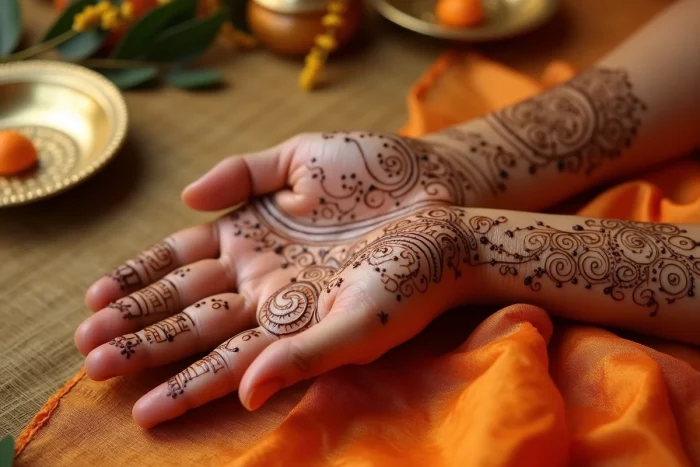
The groom, on the other hand, typically receives henna on the right palm only, in the form of a dot or a simple pattern. This gesture marks his entry into the status of husband without encroaching on the ornamental realm reserved for the woman.
The order of application, the choice of hand, and the complexity of the patterns are never trivial in the ceremonial context. They codify status, gender, and the relationship in the eyes of the assembly.
- Right hand of the bride: the most elaborate patterns, often with the name or initials of the groom hidden in the design
- Left hand of the bride: extension of the main pattern, sometimes treated as a mirror image of the right design
- Right hand of the groom: henna dot or small geometric pattern, applied by the neggafa or a female family member
Indo-Pakistani Mehndi and Asymmetrical Patterns
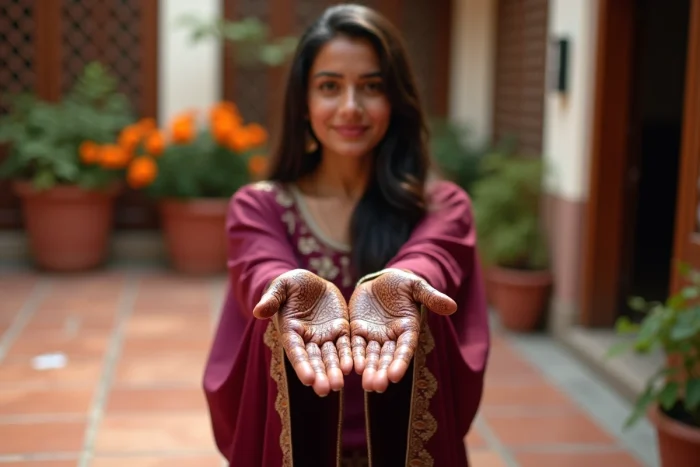
In the South Asian mehndi tradition, the right/left distinction follows a different visual composition logic. The two hands form a set designed to be seen side by side, palms open. The right hand often bears the representation of the groom, the left that of the bride, or vice versa depending on the regions.
Henna functions here as a complete iconographic program, comparable to a diptych. Symmetry is not sought: it is the narrative complementarity between the two hands that gives coherence to the design. This compositional principle is absent from most Maghreb practices, where each hand operates more autonomously.
Mehndi patterns frequently incorporate figurative elements (peacock, elephant, couple) that Maghreb henna replaces with abstract geometric or floral forms. The symbolic reading of each hand thus depends as much on regional tradition as on the graphic repertoire mobilized.
Reducing the choice between the right hand and the left hand to a personal preference ignores centuries of ritual, legal, and aesthetic codification. Whether in a Sufi context, during a wedding ceremony in Morocco, or in a contemporary beauty salon, each hand tells a distinct story, and this story deserves to be read with the right codes.