
A classic food temperature probe, when it breaks during use, can release plastic or metal fragments into a preparation. If these fragments are not detected by end-of-line control equipment, the entire batch becomes a health risk. The so-called “detectable metal” probes address this specific issue: their composition allows metal detectors and X-ray systems to identify their fragments in the event of a breakage.
Physical hazard in the kitchen: what the detectability of a probe changes
The term physical hazard refers, in HACCP terminology, to any foreign body that could injure the consumer or contaminate food. Fragments of broken utensils are part of this. Classic probes, often equipped with a standard plastic casing, pose a concrete problem: their pieces pass under metal detectors without triggering an alert.
Recent HACCP guidelines identify fragments of non-detectable plastic probes as a standalone physical hazard. The explicit recommendation is to use tools detectable by metal detection systems or X-rays in collective kitchens and the food industry.
A detectable metal food temperature probe incorporates metal particles into its casing and cable. If the instrument breaks, each piece contains enough metal to be detected by the detection gates installed on production lines or at the kitchen exit.
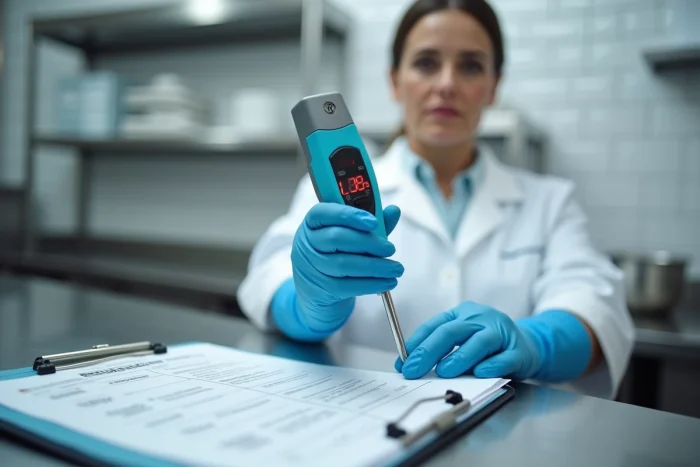
BRCGS and IFS quality standards: requirements for detectable utensils
The most widespread private food safety standards in Europe, BRCGS and IFS, have tightened their specifications on this point. These updates require certified sites to use “metal detectable” or “X-ray detectable” utensils and probes in production areas.
This requirement is not limited to large-scale food industries. Central kitchens, caterers working with cold links, and prepared meal production laboratories are also targeted as long as they provide significant volumes or operate under certification.
Why the specifications have tightened
Equipment suppliers for detection, such as Mettler-Toledo Safeline, report in their technical documents an increase in complaints related to non-detectable plastic foreign bodies in prepared dishes and trays. This observation has directly contributed to the revision of requirements in the standards.
For a certified establishment, using a non-detectable probe in the cooking area represents a potential non-compliance during an audit. Replacing all probes with detectable models thus constitutes a documentable preventive action in the HACCP plan.
Cost of a product recall related to a broken probe: the calculation that justifies the investment
A preventive withdrawal of products triggered by the suspicion of losing a probe tip in the cooking area has heavy financial consequences. Feedback from food industries describes preventive recalls of entire batches for this type of incident. The cost is not limited to the destruction of goods: it includes line stoppage, reverse traceability, crisis communication, and loss of trust from the client.
Sites that have deployed detectable metal probes report a net reduction in line stoppages and batch blockages, precisely because any potential fragment is intercepted by detectors before shipping. The additional cost of a detectable probe compared to a standard model remains marginal compared to the price of a single recall.
Criteria for choosing a detectable metal probe for professional kitchens
Not all probes marketed as “detectable” are equal. The level of detectability depends on the concentration of metal particles, the type of detector used at the end of the line, and the minimum fragment size that one wishes to detect.
- Compatibility with the detector in place: a probe designed for ferrous metal detection will not necessarily be visible on an X-ray system, and vice versa. Checking compatibility with the installed equipment avoids false feelings of security.
- The IP protection level (index of protection against water and dust): in professional kitchens, hot water splashes and high-pressure cleaning require at least an IP65 rating, ideally IP67.
- The measurement temperature range: some detectable probes are limited to narrow ranges. To cover both cold chain control (receiving goods) and cooking verification, a range from negative values to well beyond the boiling point is preferable.
- Calibration: a probe, even if detectable, must be regularly checked at the ice point or boiling point. Models that can be calibrated on-site simplify this operation without immobilizing the instrument.
Color and visual traceability
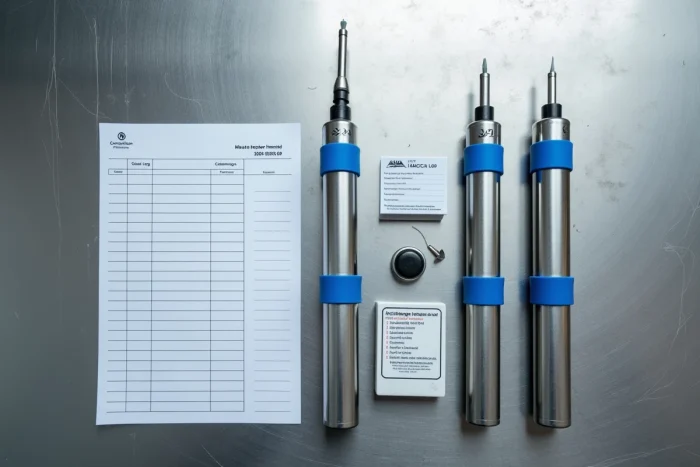
Most manufacturers offer their detectable probes in bright colors (blue, red). This choice is not aesthetic: a color absent from the food spectrum facilitates the visual identification of a fragment even before passing through the detector. Blue, in particular, is virtually non-existent in natural food products.
Integrating the detectable probe into the HACCP plan
Replacing a classic probe with a detectable model does not exempt one from documenting the change in the hazard control system. The HACCP plan must mention the type of probe used, the calibration frequency, the procedure in case of breakage, and proof of compatibility with the foreign body detector.
- Record the serial number or batch of each detectable probe in the measurement equipment register.
- Define an immediate replacement procedure in case of visible damage to the casing or cable.
- Periodically test the actual detectability by deliberately passing a broken probe sample through the line detector.
This last verification, often overlooked, ensures that the probe-detector pair functions under real production conditions. A change in the detector’s settings or a replacement of the probe with a model from another supplier may be enough to create a gap.
The choice of a detectable metal probe is less a commercial argument than a measure of technical control. In a context where BRCGS and IFS standards require concrete evidence of physical hazard management, this equipment transforms a difficult-to-control risk into a documented and verifiable control point.