
A “three-cylinder engine” (or “on three legs”) refers to an engine where one of the cylinders no longer produces effective combustion. The result is immediate: marked power loss, abnormal vibrations, and a characteristic noise, often compared to that of an old Volkswagen flat-four. This malfunction, called misfire, can affect both gasoline and diesel engines, but the causes differ significantly depending on the engine technology.
Turbocharged or atmospheric engine: a diagnosis that changes everything
Content on the subject generally treats the misfire as a unique problem. In practice, identifying the type of engine involved directs the diagnosis in very different directions.
On a naturally aspirated 4-cylinder (like VTi at PSA), misfires most often stem from progressive mechanical wear: excessive oil consumption, fouled spark plugs, and decreasing compression with mileage. The problem develops gradually.
On a turbocharged 3-cylinder (PureTech, EcoBoost 1.0), the situation is different. These modern engines combine the stresses of turbocharging and, in certain generations, known weaknesses in the timing chain submerged in oil. A misfire on this type of engine may indicate a turbo issue, contamination of the boost circuit, or chain elongation, well before the spark plugs are involved.
To delve deeper into the causes of an engine running on 3 cylinders, this distinction between turbo and atmospheric architecture is the first reflex to adopt before any intervention.
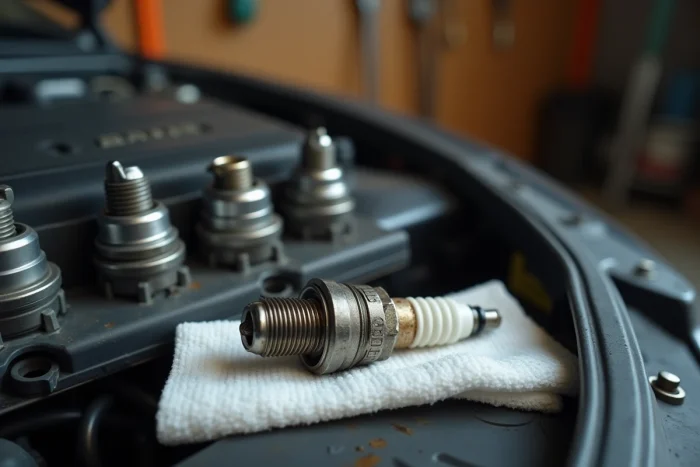
Spark plugs and ignition coils: the ignition circuit on gasoline engines
On a gasoline engine, the ignition circuit remains the first avenue to explore. A fouled, worn, or defective spark plug prevents the spark from occurring correctly in the affected cylinder.
Spark plug diagnosis
The replacement frequency for spark plugs varies according to manufacturer recommendations, usually between two major services. A blackened or oily deposit-covered spark plug indicates a combustion or oil consumption problem. When a spark plug is replaced, it is recommended to change the entire set to maintain consistent operation.
Faulty ignition coils
Individual ignition coils (one per cylinder on modern engines) are a common cause of misfire. A simple diagnostic method involves swapping the coil from the suspect cylinder with that of a functional cylinder. If the misfire follows the coil, it is the culprit. If the misfire remains on the same cylinder, the problem lies elsewhere.
An OBD diagnostic tool allows reading the associated fault codes. For example, code P0302 indicates a misfire on cylinder 2. Each cylinder has its own code (P0301 for cylinder 1, P0303 for 3, etc.).
Injectors and injection circuit: when fuel no longer reaches the cylinder
A clogged, stuck, or improperly tightened injector prevents proper fuel spray in the combustion chamber. The cylinder receives too much or not enough fuel, causing a misfire.
- On a direct injection gasoline engine, a fouled injector alters the fuel spray and degrades combustion, sometimes only when cold
- On a diesel engine, a faulty injector causes marked vibrations at idle and abnormal smoke from the exhaust
- An improperly tightened injector can create a leak that allows air into the circuit, disrupting the air-fuel mixture in the affected cylinder
Fuel contamination (water, impurities) is an aggravating factor reported on PureTech and EcoBoost engines. A fill-up at a station with poorly maintained tanks can be enough to clog an injector to the point of rendering a cylinder inoperative.

Loss of compression and deep mechanical problems
When the ignition and injection circuits are ruled out, the problem often lies within the engine’s internal mechanics. A loss of compression in a cylinder prevents any effective combustion, even if the spark plug and injector are functioning perfectly.
The possible causes are more serious:
- Faulty head gasket, allowing coolant or oil to enter the combustion chamber
- Warped or misadjusted valve that no longer seals properly
- Worn rings that no longer maintain the seal between the piston and the cylinder
- On engines with submerged timing chains, chain elongation alters the timing and disrupts valve opening
A compression test using a compression gauge allows measuring the pressure in each cylinder. A significant discrepancy between the suspect cylinder and the others confirms an internal mechanical problem.
The specific case of air leaks at the intake
A split intake hose or a malfunctioning manifold gasket allows unmeasured air to enter the sensor. The ECU prepares a mixture that is too lean for the affected cylinder. This type of failure often manifests when cold, with an engine running on 3 legs at startup and then stabilizes as it heats up, when the rubber expands and regains relative sealing.
Intervene yourself or entrust the vehicle to a professional
Replacing spark plugs or swapping coils to isolate a fault is within the reach of an individual equipped with a minimum of tools and an OBD reader. These operations do not require advanced mechanical skills.
However, a compression issue, timing chain problem, or injector issue requires specific equipment and technical expertise. Driving with an inactive cylinder accelerates catalyst wear and can damage other engine components. The unburned fuel passing through the cylinder ends up in the exhaust line, where it overheats the catalytic converter.
On recent turbocharged engines, mechanics recommend not waiting for manufacturer intervals to replace wear parts related to the timing. Preventive replacement of the chain, before it causes a timing shift, avoids a bill much heavier than anticipated maintenance.