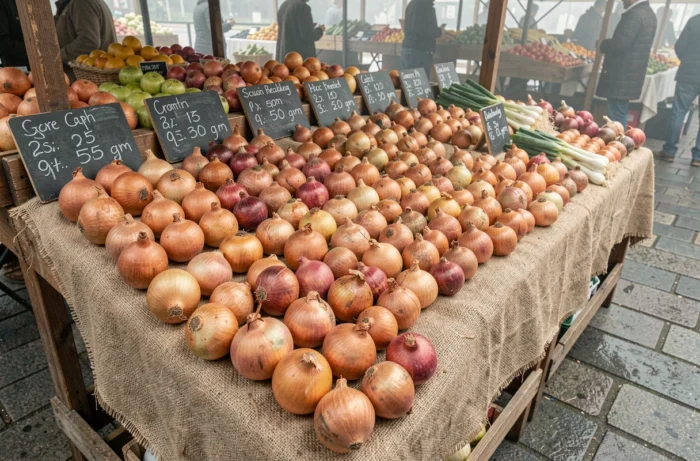
When a recipe calls for “a medium onion,” ambiguity arises. The actual weight of an onion depends less on its variety than on its size, a technical detail that remains largely ignored by consumers. Understanding what this measurement entails allows for proper seasoning of dishes, as well as a better analysis of what is offered at a market stall or in a supermarket.
Onion Size: A Measure of Diameter, Not Weight
The first instinct might be to associate size with weight. In reality, size corresponds to the maximum diameter of the bulb, measured at its equatorial section. Two onions classified in the same size can therefore have different weights depending on their shape (flattened, round, elongated), their internal density, and their water content at the time of harvest.
This distinction has direct consequences in cooking. A round and dense onion with a diameter of 65 mm will weigh significantly more than a flattened onion of the same diameter. Relying solely on visual appearance without knowing the size can lead to discrepancies in seasoning that are felt in stews or reduced sauces.
To delve deeper into the relationship between average weight and size of an onion, one must look at how professional sectors organize sorting and packaging.
Diameter Ranges in the French Market: 40-60, 50-70, 60-80 mm
Onions sold in France are sorted according to standardized diameter ranges. The three most common ranges are 40-60, 50-70, and 60-80 mm. These ranges are used for packaging in nets, bundles, or boxes for the food service industry.

Each range corresponds to a preferred use:
- Sizes 40-60 mm are found in retail nets (1 kg nets in supermarkets) and are suitable for food service when the onion is used whole or in wedges.
- Sizes 50-70 mm represent the versatile format, suitable for classic retail and most home preparations (soups, stir-fries, sauce bases).
- Sizes 60-80 mm are sought after for cutting into regular slices or for certain lines of industrial processing, where the size of the bulb affects cutting yield.
Shallots or “sauciers,” on the other hand, fall below the 40 mm mark (size 20-40 mm). They are sold for specific uses: whole preparations, pickles, garnishes for sauced dishes.
Why Two Onions of the Same Size Do Not Weigh the Same
The shape of the bulb plays a crucial role. A yellow onion of the Paille des Vertus type, which is rather round and firm, contains more material for a given diameter than a red onion from Florence, which is often more flattened. Shape, density, and water content explain the weight discrepancies at the same size.
Water content also varies depending on the harvest date and storage conditions. A fresh onion from the beginning of the season contains more water than a stored onion sold in winter after several months of drying. The latter will have lost weight without any visible change in diameter.
The mode of production also plays a role. Field reports vary on this point, but planting density and fertilization levels influence the final distribution of sizes in a given plot. A dense sowing tends to produce smaller bulbs, while wider spacing favors larger sizes.
Yellow, Red, White Onions: Does Size Vary by Color?
Yellow onions dominate the French market in volume and come in all size ranges. Storage varieties like Sturon or Paille des Vertus are selected to produce regular bulbs between 50 and 80 mm.
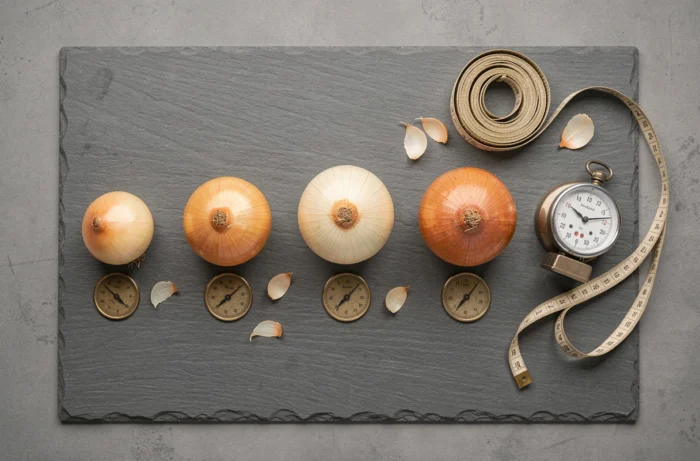
Red onions are often sold in slightly smaller sizes than yellow ones, partly because demand is for raw uses (salads, pickles) where a smaller size suffices. In contrast, white onions sold in bundles in spring do not follow the same sizing logic: they are harvested before full maturity, with a still underdeveloped bulb.
Sweet onions, such as Cévennes or certain imported varieties, reach larger sizes. Their less dense and more watery flesh gives them a different diameter/weight ratio compared to classic storage onions.
Choosing Your Onion Based on Use: Beyond the Displayed Size
Size remains a professional sorting indicator, not a guarantee of weight for the cook. To adapt purchases to recipes, a few concrete guidelines help navigate this.
A medium onion from the market generally corresponds to size 50-70 mm. This is the size that most cookbooks refer to when they say “an onion.” For a recipe that calls for “a large onion,” one should aim for size 60-80 mm.
At the market or in bulk, weighing the onion remains the most reliable method. Pre-packaged nets display a total weight but rarely the individual size. Size information is more often found on packaging intended for professionals (boxes, bags of several kilograms).
One last point deserves attention: large retailers tend to favor uniform sizes for display reasons. Short supply chains or farmers’ markets offer a more variable size distribution, which can be an advantage when looking for a small size for a blanquette or a large onion for stuffing.
Size does not tell everything about the product. It remains a measure of diameter, useful for sorting and packaging, but insufficient to predict the exact weight of a bulb. Weighing the onion at the time of purchase or preparation remains the safest action to respect the proportions of a recipe.