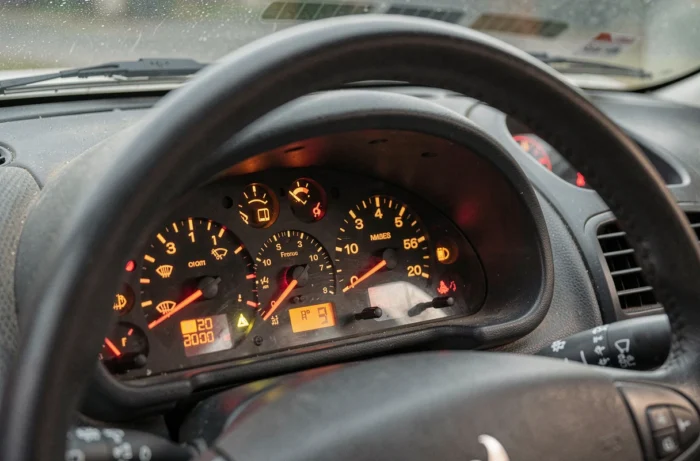
On the Peugeot 206, the BSI (Built-in Smart Interface) unit centralizes the management of warning lights. Each light on the dashboard represents a state reported by a sensor or a dedicated control unit. Understanding the logic behind these alerts helps avoid late diagnoses and collateral mechanical damage.
Airbag Warning Light on Peugeot 206: The Trap of the SRS Circuit and Takata Recalls
The airbag warning light being permanently on does not necessarily indicate a faulty airbag. On the 206, the issue often comes from the peripheral SRS circuit: the rotary switch under the steering wheel, the seatbelt pretensioner, or a connector located under a passenger seat. A simple adjustment of the seat or an intervention in the cabin can be enough to trigger the fault.
We recommend not relying on a generic OBD reader to query the airbag system. The SRS control unit of the 206 requires a tool compatible with the PSA protocol (Diagbox, PP2000, or equivalent) to read and clear specific fault codes.
One often overlooked angle concerns the Takata airbag recall campaign. In France, some Peugeot vehicles are affected by recalls classified as “stop drive.” The airbag warning light alone does not identify this risk. The owner must check their VIN on the manufacturer’s official portal or on the government portal dedicated to recalls.
As of January 1, 2026, a vehicle affected by a serious unrepaired airbag recall may be subject to a re-inspection during the technical control, or even a prohibition to drive depending on the classification of the fault (decree n° 2025-1180 of December 8, 2025). The meaning of the dashboard lights on the Peugeot 206 therefore goes beyond simply reading an icon: it engages the vehicle’s regulatory compliance.

STOP Light and Red Warning Lights: Hierarchy of Engine Urgencies on the 206
The centralized STOP warning light is the most critical. When it lights up while driving, it is always accompanied by another red light and requires an immediate stop of the vehicle.
Three situations require cutting the engine without delay:
- Engine oil pressure light (oil can symbol) lit steadily, engine running. Loss of pressure can destroy the crankshaft bearings in a matter of minutes. Check the oil level before any attempt to restart.
- Coolant temperature light in red. Exceeding the normal temperature causes the cylinder head to warp. On the TU engine of the 206, overheating quickly damages the head gasket.
- Brake fluid level light or fault in the electronic brake force distribution system (REF). Braking efficiency is compromised, and the vehicle should not be driven.
The battery charge light (battery symbol) indicates a failure in the alternator’s charging. The engine continues to run on the battery reserve, but the remaining range is limited to a few kilometers. We observe that on the 206, a worn accessory belt tensioner is a common cause of this fault.
Orange Warning Lights on Peugeot 206: Engine and Emission Diagnostics
Orange lights do not require an immediate stop but indicate a malfunction that needs to be addressed quickly. The most common on the 206 is the engine light (check engine), related to the engine management and emission control system.
Solid or Flashing Engine Light
A solid engine light indicates a fault recorded by the injection control unit. Common causes on the 206 include a faulty lambda sensor, an intake circuit issue, or a failing crankshaft position sensor (CMP). The vehicle can still run, but fuel consumption and emissions increase.
A flashing engine light signals detected misfires in real-time. The situation is more urgent: unburned fuel can damage the catalyst. We recommend immediately reducing engine speed and consulting a workshop within the day.
ABS and ESP Lights
The anti-lock braking system (ABS) light being on indicates that the ABS system is disabled, but conventional braking remains operational. On the 206, the wheel speed sensor is the most frequently implicated part, especially on front axles exposed to debris.
The ESP (or ASR depending on the version) light indicates a deactivation of stability control. The vehicle remains drivable, but cornering behavior or driving on slippery surfaces is no longer electronically corrected.

Green and Blue Lights: Information Indicators on the 206
Green and blue lights do not indicate any anomalies. They confirm the activation of a function:
- Low beam, position lights, front or rear fog lights activated.
- High beams (blue light) in operation. This light is often mistaken for a fault by drivers unfamiliar with the vehicle.
- Turn signals and hazard signal (flashing green arrows).
The only point of attention concerns the preheating light (diesel). It lights up briefly at startup, which is normal. If it remains on or flashes while the engine is running, it indicates a fault in the preheating system or the diesel injection control unit.
The color logic (green for information, orange for caution, red for urgency) remains the first reflex to adopt in the face of an unknown light. A red light always requires stopping the vehicle, without exception. Using a PSA-compatible diagnostic tool remains the most reliable method to precisely identify the origin of a fault on this generation of Peugeot.