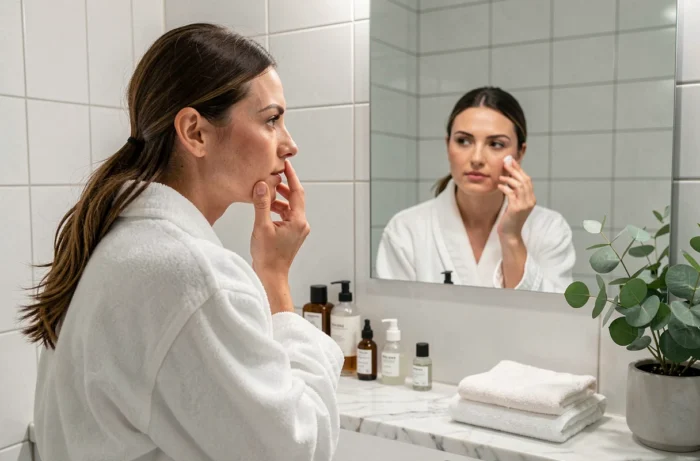
The SPF displayed on a day cream does not provide as much protection as a dedicated sunscreen, the INCI list remains unreadable for most informed consumers, and ten-step routines generate more pilling than results. Here we address the technical points that separate an effective beauty routine from a stack of poorly sequenced products.
SPF integrated into a day cream: an overestimated protection
A foundation or moisturizer with an SPF of 30 does not deliver the same protection as a sunscreen formulated for that purpose. The SPF value is measured in a laboratory with a standardized amount of product per square centimeter of skin, a dose that no one applies in practice with a simple day cream.
We recommend treating UV protection as a standalone step. A dedicated broad-spectrum sunscreen remains the only reliable option when exposure warrants it. The SPF of a moisturizer can complement, but not replace.
Regulation (EU) 2024/996 has also removed 4-Methylbenzylidene Camphor from the list of authorized UV filters, following an opinion from the Scientific Committee on Consumer Safety pointing out its potential endocrine effects. Checking the composition of your current sunscreens is not a luxury: it’s a reflex to integrate right now. By browsing Style Beauté’s beauty tips, you will find additional guidelines to refine your daily skincare choices.
INCI Reading: decoding the actual concentration of active ingredients

Consumer guides recommend choosing a serum with hyaluronic acid or vitamin C without ever explaining how to estimate the actual concentration of the active ingredient in the product. The INCI list, mandatory on the packaging, follows a ranking by decreasing concentration down to the threshold of 1%. An active ingredient listed after fragrance generally has a concentration below 1%.
In practical terms, if retinol appears at the end of the list, after preservatives and fragrance, the formula contains a symbolic amount. This is not necessarily a problem (some actives work at low doses), but it changes the promise of the product.
Three guidelines for reading a label effectively:
- Locate the position of the highlighted active ingredients on the packaging relative to fragrance (often listed under “fragrance” or “parfum”). Before the fragrance, the concentration is likely above 1%. After, it is marginal.
- Identify the total number of ingredients. A short formula (less than twenty entries) concentrates each component more than a formula with forty lines at the same price.
- Beware of duplicated INCI names. Some brands list several forms of the same active separately so that it appears in multiple places on the list, which gives an impression of higher concentration.
The INCI list is the only objective tool accessible to consumers to evaluate what a product actually contains. Mastering it transforms every purchase into an informed decision.
Pilling and incompatibilities between facial care products
The stacking of incompatible textures remains the primary cause of pilling. This phenomenon, which we frequently observe, is not related to the quality of the products taken individually but to their chemical and physical interaction once layered.
Silicone-based formulas (dimethicone, cyclopentasiloxane) create an occlusive film. Applying a water-based serum loaded with polymers on top causes an almost systematic rolling effect. The order and penetration time change everything.
Waiting two to three minutes between each layer significantly reduces pilling. In practice, this means that a routine with five products requires a minimum of eight to ten minutes, including drying time. Any routine advertised as quick and involving more than three steps relies on a compromise of penetration.
Points to watch out for to avoid incompatibilities:
- Apply textures from the most fluid to the thickest: water, water-based serum, light emulsion, rich cream, oil, then sunscreen.
- Avoid layering two products with heavy silicones (silicone cream followed by silicone foundation) without an intermediate water-based base.
- Reduce the number of steps if pilling persists. Three well-absorbed products are better than six that pill.

Morning routine and evening routine: two distinct logics for facial care
The morning routine and the evening routine do not share the same objective. Treating them the same way, by stacking the same categories of products, is a common design error.
In the morning, the skin needs protection and preparation for potential makeup. Cleansing can be limited to a gentle rinse or micellar water. The antioxidant serum and sunscreen form the foundation of the morning care. Any additional step must be justified by a specific need (redness, marked dehydration).
In the evening, the priority shifts to deep cleansing and repair. Double cleansing (oil or balm followed by a water-based cleanser) removes makeup residue, pollution, and accumulated sebum. It’s also the time to incorporate potentially irritating actives (retinol, exfoliating acids), as the skin is not exposed to UV during the night.
We observe that the most effective routines over time are those that remain manageable. A routine of three to four products followed every day always surpasses a routine of eight products abandoned after two weeks. Consistency takes precedence over sophistication.
The choice of textures and actives deserves to be reevaluated with each change of season. A rich cream suitable in winter weighs down the skin in summer, and a light serum sufficient in July does not compensate for December’s dehydration. Adjusting twice a year, at a minimum, maintains effectiveness without multiplying purchases.