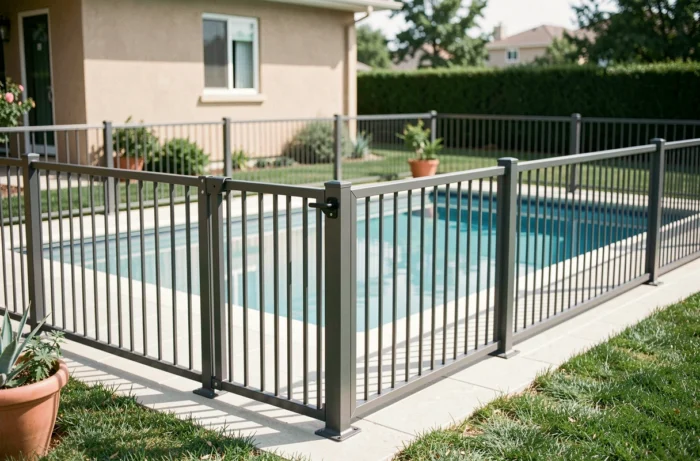
The pool fence is part of the safety devices regulated by French law since 2003. The obligation applies to in-ground or semi-in-ground private pools, whether installed in a primary residence, secondary residence, or rental accommodation. The applicable legal reference is now found in Article L.134-10 of the Construction and Housing Code, which replaced the previous numbering L.128-1.
Article L.134-10 and standard NF P90-306: two texts, two distinct scopes
A common confusion is treating the NF P90-306 standard as the legal rule itself. The law requires a safety device that complies with regulatory requirements. The standard, on the other hand, serves as the technical reference that allows for the assessment of whether a barrier, its gate, and its resistance meet the expected criteria.
This distinction has practical consequences. A manufacturer can label their product as “compliant with standard NF P90-306,” but this label does not guarantee the compliance of the entire installation. The positioning of the fence relative to the pool, the ground fixation, and the adjustment of the gate: all of this falls under on-site implementation, not the product certificate.
To understand the pool fence standards to be respected, it is necessary to read both the legal text and the technical reference together, without considering one as a substitute for the other.
Regulatory height of the pool fence: what the standard actually requires
The NF P90-306 standard sets a minimum height of 1.10 meters for the protective barrier. This measurement is taken from the finished ground on the outside to the top of the fence. On sloped terrain, the height must be respected at all points of the perimeter, which sometimes complicates installation.
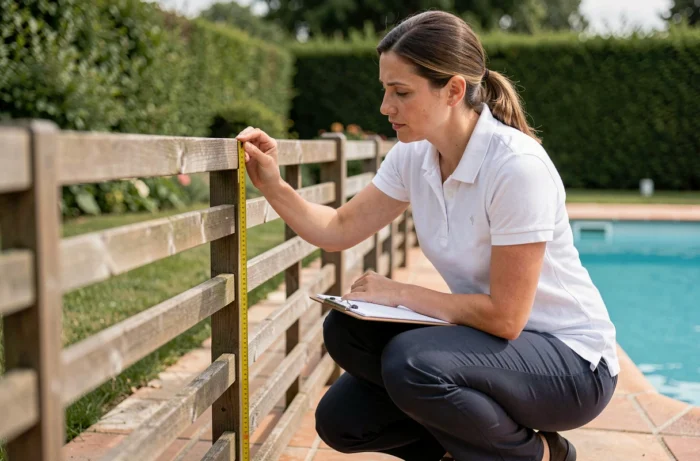
Beyond height, the standard also regulates spacing. The gaps between the bars or panels must not allow a child to pass through or provide a foothold that facilitates climbing. The design of the infill (vertical bars, glass panels, mesh) must prevent a child from being able to climb or slip through.
Gate and locking system
The access gate must close and lock automatically after each opening. The unlocking system is designed to be out of reach of a young child, typically placed high or requiring a combined action that the motor skills of a child under five years old do not allow.
A gate that remains open or whose latch is accessible nullifies the protective function of the entire fence. Field reports show that this point is one of the most frequently overlooked during inspections.
Collective use pools and rental accommodations: a broader scope than one might think
The obligation is not limited to strictly family pools. Private pools for collective use are also concerned. This includes pools accessible in cottages, guest houses, campsites, or holiday residences.
- A property owner renting their house with a pool on a seasonal rental platform must install a compliant device before the first rental.
- Establishments open to the public with a private pool are subject to the same requirements, sometimes with additional constraints specific to ERP.
- Above-ground pools, on the other hand, are not covered by this obligation unless they are buried or semi-buried in the ground.
For seasonal rentals, the owner’s liability is engaged in the event of an accident, even if a tenant has disabled or circumvented the device. Checking the condition of the fence between rentals is therefore a point not to be overlooked.
Sanctions and compliance verification: what a property owner risks
Failure to comply with the obligation to install a standardized safety device exposes the owner to a fine of up to 45,000 euros. This sanction applies both in the complete absence of a device and in the presence of a non-compliant installation.
The available data do not provide precise information on the frequency of inspections carried out by authorities on private pools. However, compliance is often checked in the event of an accident, a real estate sale, or a neighbor’s report.
PLU and local rules
The NF P90-306 standard sets a national baseline, but the local urban planning plan (PLU) of each municipality may impose additional constraints. Some municipalities require specific materials, colors, or heights exceeding the regulatory minimum. Before any installation, consulting the town hall’s urban planning department can prevent future compliance work.
Pool fence materials: aluminum, glass, or wood
The choice of material is not solely aesthetic. Each material must withstand the loads defined by the standard without deforming. Tempered glass, powder-coated aluminum, and treated wood are among the common options.
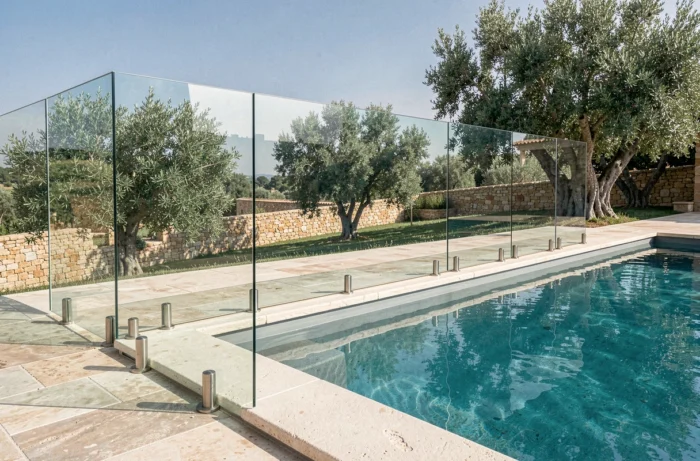
- Tempered glass offers total transparency over the pool but requires regular maintenance to avoid limescale marks that reduce visibility.
- Aluminum combines lightness and corrosion resistance, making it suitable for salty or humid environments.
- Wood provides a natural look, provided a species or treatment compatible with permanent exposure to moisture and chlorinated splashes is chosen.
Regardless of the chosen material, the strength of the ground fixation remains the determining factor. A poorly anchored tempered glass fence in soft ground does not fulfill its role, even if the panel itself is certified compliant.
The regulations on pool safety have not changed in principle since 2003, but the change in numbering in the Construction Code (Article L.134-10) and the clarifications provided by the DGCCRF on the scope of seasonal rentals remind us that the legal framework remains active. Checking the compliance of one’s installation, including the functioning of the gate and the condition of the fixings, remains the most concrete measure for an owner.