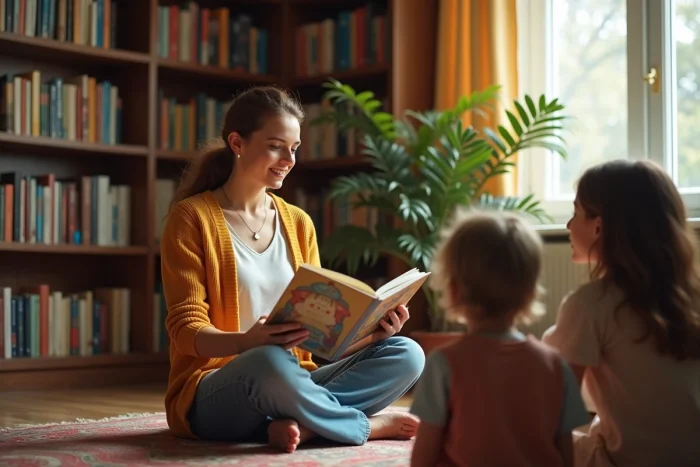
Telling a story, whether to a child or an adult, relies on a set of precise narrative mechanisms. Oral or written narration mobilizes voice, rhythm, story structure, and interaction with the audience. Before being an innate talent, it is a skill based on identifiable and reproducible techniques.
Narrative Focus: The Lever Most Stories Neglect
The way we position the point of view in a story radically changes its reception. Telling a tale from the perspective of the main character (internal focus) or from an outside narrator (external focus) does not produce the same effect on the audience, especially among children.
Recent work in neuroscience, particularly that of Mar and Weibe published in 2023 in Trends in Cognitive Sciences, shows that the alternation of narrative points of view enhances theory of mind in children. Switching between a character’s perspective and that of an omniscient narrator encourages the listener to represent the emotions of multiple protagonists, which develops empathy.
Specifically, when you tell a story, shift from “he was scared” (external narrator) to “I felt my heart beating” (character’s voice). This shift, even if brief, forces the child to mentally reconstruct the character’s emotional state. The adult listening to a story structured this way also finds a renewed attention, as the variable focus creates narrative surprise.
The platform Raconte-moi offers stories that exploit this type of narrative variation, making it a useful resource for exploring different ways to tell stories to children.

Co-storytelling: Telling a Story with Two Voices with the Child
Co-storytelling refers to a practice where the adult and child build the narrative together. The adult sets up a situation, the child decides what happens next, and then the adult introduces an obstacle or a new character.
This approach goes beyond simple read-aloud. A qualitative survey by UNICEF conducted in 2022 across several European countries highlighted that co-created storytelling helps children manage their emotions, particularly fear and anger. The child who chooses how their character reacts to danger projects their own emotional regulation strategies into the narrative.
Three Principles for an Effective Co-storytelling Session
- Ask open-ended questions about the character’s emotions (“What do you think the wolf feels at this moment?”) rather than closed questions about the plot
- Accept narrative digressions proposed by the child, even if they break the logic of the story, as it is in these digressions that emotional expression occurs
- Alternate roles: the child becomes the narrator for a few sentences, then returns to being the listener, which works on both creativity and listening skills
This technique also works between adults. In training or writing workshops, the co-construction of a narrative with multiple voices produces richer stories and develops participants’ active listening skills.
Rhythm and Voice: The Physical Tools of the Storyteller
An engaging narrative does not solely depend on its content. The rhythm of the voice structures the audience’s attention as much as the plot itself.
Slowing down before a key moment creates suspense. Speeding up during an action scene conveys urgency. Pausing after a revelation allows time for the emotion to settle. These tempo variations are the concrete tools of the storyteller, whether addressing a three-year-old or an adult audience.
The Voice as a Character
Modifying the tone for each character is not just a gimmick. When the adult uses a deep voice for the giant and a high voice for the mouse, they provide the child with an auditory cue that facilitates understanding of the narrative. For younger children who do not yet master all the subtleties of language, these vocal cues replace written descriptions.
For the adult listener, vocal variations maintain engagement. Speakers and trainers who tell anecdotes while modulating their voice hold attention much longer than those who deliver a monotone speech.

Structuring a Captivating Narrative: Temporality in Service of Emotion
Every story relies on a temporal structure. The choice of this temporality, whether linear, in flashback, or cyclical, profoundly alters the listener’s experience.
For children, the linear structure (beginning, complication, resolution) remains the most accessible. It offers a predictable framework that reassures. Almost all traditional tales use this scheme, and it is precisely this predictability that allows the child to focus on emotions rather than on understanding the plot.
For an older or mixed audience, introducing a temporal shift (starting with the end, then going back to the causes) creates a curiosity effect. The listener knows the outcome but seeks to understand the journey, generating a different form of engagement.
- Linear narrative: suitable for children under six and bedtime stories, as it follows a natural order that aids in falling asleep
- Inverted suspense narrative: effective for older children and adults, as it turns the listener into an investigator
- Cyclical narrative (the story ends as it begins): particularly appreciated by young children who find joy in repetition and motif recognition
The choice of structure depends on the audience’s age and the story’s objective: to soothe, stimulate reflection, or provoke laughter.
Telling stories is not just about choosing a good book or inventing an original plot. Narrative focus, interaction with the audience, voice work, and temporal structure form a set of skills that can be developed separately and combined.
A narrative delivered with a monotone voice but a surprising temporal structure will captivate differently than a linear narrative supported by an expressive voice. Adapting these parameters to your audience, whether they are three or forty, remains the only rule that truly matters.