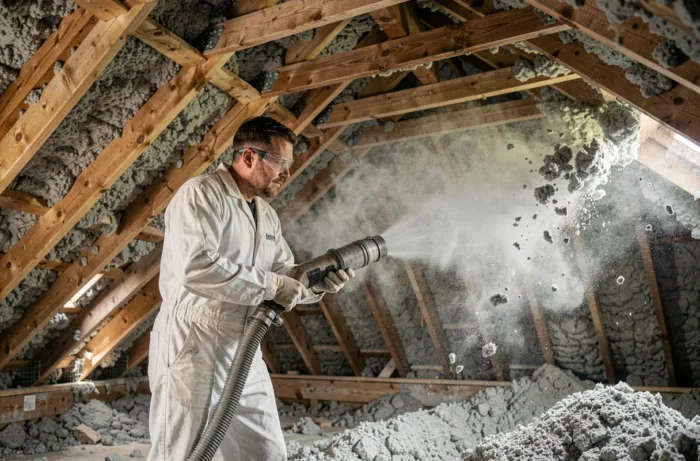
Insulating lost attics with blown cellulose wadding in bulk seems simple on paper. The material arrives in bags, a machine blows it, and the thermal resistance stated on the product sheet does the rest. In practice, the quality of the result depends as much on the product itself as on the supplier who delivers it and the installer who implements it.
Choosing a bulk cellulose wadding supplier means checking a series of technical guarantees even before comparing prices.
Settling class and installation density: what the quote must mention
Bulk cellulose wadding naturally settles after installation. This settling reduces the actual thickness of the insulation, thus its thermal resistance. A reliable supplier incorporates this phenomenon right from the quote.
Why does this point deserve your attention? Because two products displaying the same lambda can yield very different results once installed, depending on their blowing density and settling behavior. The settling class, documented in the ACERMI certificate, quantifies this discrepancy.
Before signing, check that the quote explicitly mentions four elements:
- The ACERMI certificate number of the delivered product, which certifies that the performance has been tested in a laboratory by the CSTB and the LNE.
- The targeted installation density in kg/m³, suitable for the configuration of your attics or walls.
- The thickness actually blown before settling, and not the theoretical final thickness.
- The number of bags needed for the area to be treated, which allows recalculating the actual density.
A supplier who refuses to detail this information or who merely announces a thermal resistance “R” without specifying the installation conditions deserves the utmost caution. Choosing a bulk cellulose wadding supplier implies being able to verify the consistency between the advertised product and the product actually installed.
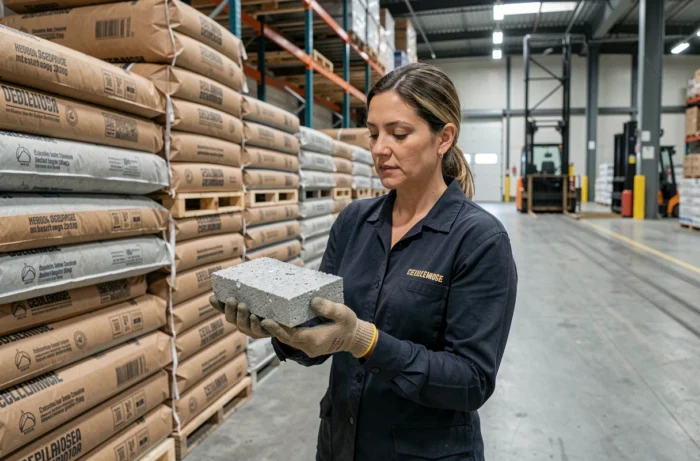
Compliance with NF EN 15101 standards and CE marking of cellulose wadding
The French market for bulk insulation is governed by two complementary standards. The NF EN 15101-1 standard concerns the product itself (characteristics declared by the manufacturer). The NF EN 15101-2 standard pertains to the implementation, that is, how the insulation is blown or injected.
These two standards serve as the basis for CE marking. A product lacking this marking should simply not be marketed in France for thermal insulation use.
Have you noticed that some retailers offer cellulose wadding at very low prices? In most cases, the price difference is explained by the absence of certification or by an imported product whose tests were not conducted according to French standards. Checking for the presence of the CE marking and the ACERMI certificate remains the first filter to eliminate dubious offers.
The case of CSTB Technical Opinions
Beyond the CE marking, some manufacturers have a Technical Opinion (AT) issued by the CSTB. This document describes the validated conditions of use for the product: type of support, minimum thickness, vapor barrier required or not. A supplier capable of providing you with the Technical Opinion for the product they distribute demonstrates a level of transparency above average.
FDES and INIES database: a strategic criterion for new projects
If your project falls under RE2020 or the upcoming RE2025, the choice of supplier takes on an additional dimension. These regulations require calculating the carbon impact of the building over its life cycle. For cellulose wadding to be considered in this calculation, the product must have an FDES (Environmental and Health Declaration Sheet) registered in the INIES database.
Without an FDES, the calculation software applies a default value that is often penalizing. The building then loses the actual environmental advantage of cellulose wadding, which can compromise the project’s compliance.
Specifically, ask your supplier about this precise point: is the product they offer referenced in the INIES database? Can they provide the link to the corresponding FDES? A supplier who masters this subject generally works with manufacturers committed to an environmental transparency approach.
Bulk cellulose wadding: common pitfalls when purchasing
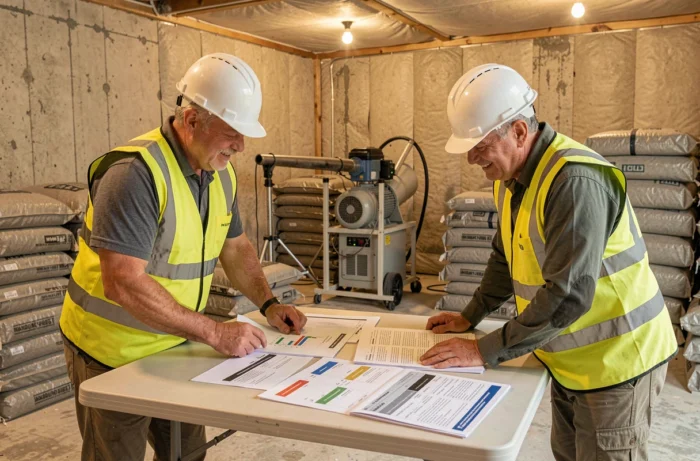
The price per bag is not enough to compare two offers. A cheaper bag but containing a product with a higher lambda requires a greater installation thickness to achieve the same thermal resistance. The final cost per square meter, at equal thermal resistance, can then reverse.
Always compare the cost relative to the targeted R, not to weight or gross volume. This reflex avoids unpleasant surprises regarding the actual number of bags consumed.
Another common pitfall concerns fire treatment. Cellulose wadding contains boron salts or other additives to resist fire and mold. Some low-cost products use less durable treatments or insufficient quantities. The ACERMI certificate and the CSTB Technical Opinion allow you to verify that the treatment meets regulatory thresholds.
Delivery and storage before the project
Bulk cellulose wadding is sensitive to moisture. A rigorous supplier delivers the bags on a wrapped pallet and specifies the storage conditions. Bags delivered wet or stored outside without protection lose some of their properties even before installation. Demand delivery in intact bags, stored dry, and check the condition of the batch upon receipt.
Ultimately, choosing a bulk cellulose wadding supplier relies on their ability to document each step, from the product certificate to the delivery conditions. A detailed quote, a certified ACERMI product with a registered FDES, and controlled storage conditions form the foundation of effective insulation over time.