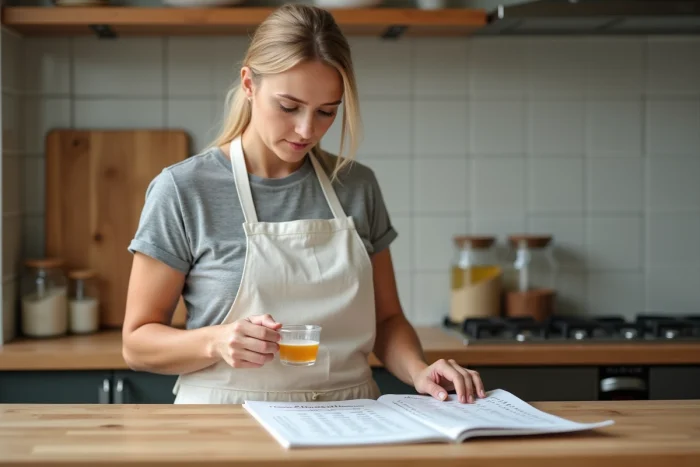
500 g of honey is poured into a graduated container and 350 mL is read on the scale. The count is off, and the recipe goes awry. The problem does not stem from the measurement, but from a confusion between mass and volume that only a reflex can correct: going through the density of the ingredient.
Density of ingredients: the missing link between grams and liters
A gram measures mass. A liter measures volume. These two quantities do not describe the same thing, and without density, no gram-liter conversion is reliable. Density (sometimes called specific mass relative to water) indicates how many grams weigh a milliliter of a given product.
For pure water, the density is 1: 1 liter weighs 1,000 g. One can use a table to convert grams to liters to visualize this relationship for other ingredients, as soon as we move away from water, the discrepancies widen quickly.
Olive oil, being lighter, has a density close to 0.92. Honey, significantly heavier, is around 1.4. In practice, this means that a liter of oil weighs less than a liter of water, and a liter of honey weighs considerably more.
The formula to remember
The relationship is simply written as: Volume (L) = Mass (g) ÷ (density × 1,000). Conversely, to find the mass: Mass (g) = Volume (L) × density × 1,000. You set the density of the ingredient, apply the formula, and you’re done.
All the difficulty lies in knowing this density. Practical tables exist precisely to avoid having to look it up every time.

Gram-liter conversion table for common liquids in cooking
The generic tables found online often limit themselves to metric prefixes (kilo, deci, milli) and remain within a single quantity. Useful for converting centiliters to liters, but it doesn’t solve anything when you need to convert grams of flour into volume.
An operational table groups ingredients by family and displays, for each, the mass corresponding to one liter.
| Ingredient | Approximate Density | Mass for 1 liter |
|---|---|---|
| Water | 1.00 | 1,000 g |
| Whole milk | 1.03 | 1,030 g |
| Oil (olive, sunflower) | 0.92 | 920 g |
| Honey | 1.40 | 1,400 g |
| Wheat flour | 0.55 to 0.65 | 550 to 650 g |
| Granulated sugar | 0.85 | 850 g |
With this type of table in front of you, it is immediately clear that 200 g of flour does not occupy the same volume as 200 g of milk. Flour, very light per liter, occupies almost double the volume compared to milk for the same mass.
Quick reading of the table
You identify the ingredient, read the “mass for 1 liter” column, and apply a rule of three. To convert 500 g of honey to liters: 500 ÷ 1,400 = about 0.36 L, or 36 cL. For 250 g of oil: 250 ÷ 920 = about 0.27 L.
This reflex effectively replaces approximate conversions based on cups or spoons, whose capacity varies by manufacturer.
Common mistakes when converting grams to liters without a table
The first mistake, and the most widespread, is to apply the ratio 1 g = 1 mL to all ingredients. This shortcut only works for water. For honey, the discrepancy can reach nearly 40% too much. For flour, you end up with a significantly underestimated volume.
Another classic trap: confusing capacity units and mass units in a recipe. When a recipe states “200 g of flour” and you measure 200 mL in a measuring cup, you actually get much less flour than expected, because packed flour and aerated flour do not have the same apparent density.
- Check if the recipe refers to grams (mass) or milliliters/centiliters (volume) before any conversion.
- Use a kitchen scale for dry ingredients: it’s more reliable than a measuring cup, as the apparent density changes with packing.
- Keep a density table displayed near the work surface for ingredients that are used often (oil, milk, flour, sugar).
Feedback varies on the exact density of flour depending on whether it is sifted or not, which can create a notable discrepancy in large volumes.

Gram-liter conversion beyond cooking: practical cases
The gram-liter conversion is not only about recipes. In DIY, dosing a resin-hardener mixture requires the same rigor. In gardening, liquid fertilizers are often dosed in grams per liter of water. The reasoning remains the same: mass, density, volume.
For concentrated household products, whose density often exceeds that of water, pouring “one liter” based on the weight indicated on the packaging leads to overdosing. A quick calculation using the formula or an appropriate table prevents waste and unpleasant surprises.
When the scale is enough
For liquids close to water (vinegar, fruit juice, broth), the density difference remains small. One can reasonably consider that 100 g corresponds to 10 cL without significant error. However, as soon as a product is viscous, sweet, or high in fat, the density table becomes the only reliable tool.
The simplest solution remains to display a synthetic table grouping the ingredients that are regularly handled, with their density and the equivalence for one liter. Two minutes of preparation that avoid repeated errors, whether at a work surface or a workbench.