Choosing materials for construction or renovation involves more than comparing prices per square metre. RE2020 now sets a carbon trajectory across a building’s entire life cycle, with thresholds that become stricter depending on when the building permit application is submitted. A material that performs well when installed can become a problem when it is removed if there is no local channel for recovery or reuse.
Future disassembly and reuse: the criterion missing from quotes
Most material comparisons stop at three columns: price, thermal performance and durability. The product’s end-of-life cycle is left out of the analysis.
Yet the decree of 12 December 2022, amended on 22 April 2026, requires data on reuse and repurposing to be provided across several sectors, including construction materials. In practical terms, a product that can be cleanly dismantled and reused is worth more than one that is irreversibly glued or welded in place.
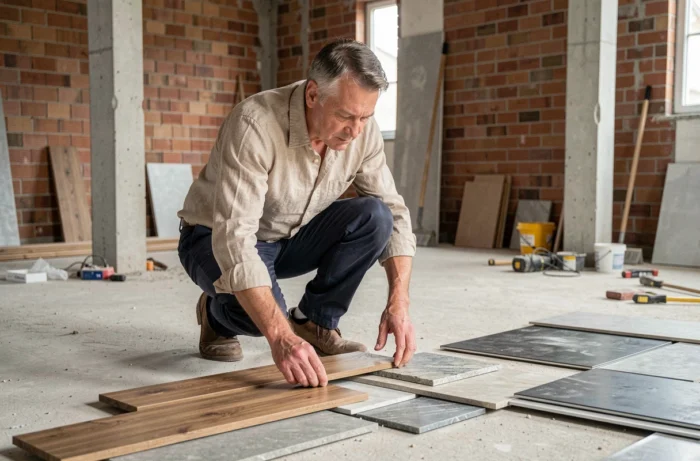
A timber cladding fixed with screws can be removed in a few hours and sold on the reuse market. Composite cladding bonded to insulation ends up in a skip, with disposal costs to match. With comparable thermal performance, the first option reduces the building’s total cost of ownership. For more on these differences, bricosuccess-immo.fr’s materials guides on Quartier Immo provide detailed product-category information.
The REP PMCB scheme (extended producer responsibility for construction products and materials) is currently being overhauled. The terms for taking back construction-site waste may therefore change, so it is best to plan ahead by choosing materials that already have an established recovery channel.

Construction materials: comparison by use and thermal performance
The four main material groups do not meet the same requirements. The table below compares their characteristics against the criteria that really matter in a property project.
| Material | Main use | Thermal performance | Reuse potential | Carbon impact (life cycle) |
|---|---|---|---|---|
| Wood (framing, cladding) | Structure, finish | Good (low thermal conductivity) | High if screwed/bolted | Low (carbon storage) |
| Concrete | Foundations, slabs, load-bearing walls | Average (requires added insulation) | Low (destructive demolition) | High (cement production) |
| Brick (clay) | Walls, partitions | Good (thermal mass) | Moderate (reuse possible with suitable mortar) | Moderate |
| Steel | Roof framing, structure | Low (thermal bridging) | High (dismantling and recycling) | Variable (recycled vs. new) |
Wood offers the best combined profile for thermal performance and reuse potential. Recycled steel is similarly easy to dismantle, but requires thermal bridging to be addressed, adding to insulation costs.
Concrete remains the most widely used material for foundations, where no alternative currently offers the same balance of mechanical strength and cost. For walls and partitions, however, brick and wood offer alternatives with measurable environmental benefits.
Thermal insulation: how choosing local materials makes a difference
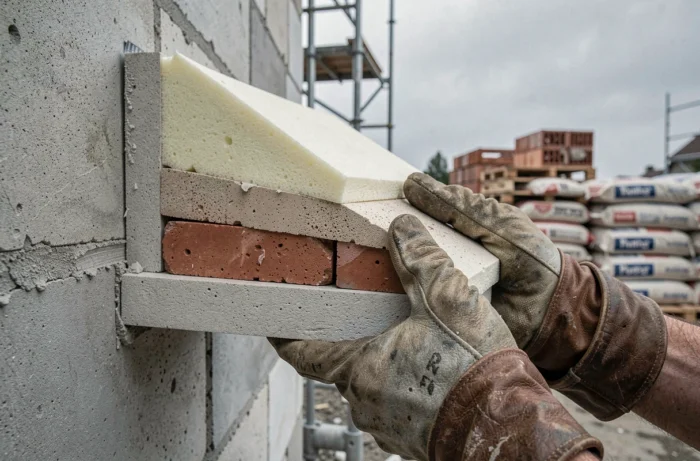
In energy-efficiency renovations, insulation accounts for a significant share of the project budget. Bio-based insulation materials (wood fibre, cellulose wadding, hemp) are gaining ground against synthetic insulation (polystyrene, polyurethane).
Raw thermal performance alone is not enough to distinguish between two insulation materials. Their hygrothermal behaviour, service life and end-of-life options matter just as much. Wood fibre insulation regulates moisture in the wall, whereas polystyrene creates an impermeable barrier that can trap condensation.
In its observations published on 16 October 2026, CAPEB highlighted that the distance to construction-waste collection points has a real bearing on contractors’ choices. Bio-based insulation offcuts that can be composted or recycled locally cost less to manage than synthetic insulation that must be transported to a specialist treatment facility several dozen kilometres away.
- Before work begins, check whether a REP PMCB collection point accepts the waste category generated by the chosen insulation, and how far away it is
- Compare the total cost: material price + installation + offcut disposal + any additional transport costs to the collection point
- Prioritise insulation materials with a recycling or composting channel already operating in the area where the work is being carried out
RE2020 and carbon impact: what the building permit sets in motion
For new buildings, RE2020 does more than set energy performance requirements. It takes into account the carbon impact of materials across the building’s entire life cycle, from raw material extraction through to demolition.
Carbon thresholds become stricter in successive stages. The applicable stage depends on the date the building permit application is submitted. A project submitted later in a regulatory cycle may face stricter requirements than a similar project submitted just a few months earlier.
This has a direct impact on material choices. A cast-in-place concrete wall that met the first-stage thresholds may no longer comply at the next stage, requiring a switch to timber framing or low-carbon brick. The permit timeline therefore determines which materials are available as options.
- Check which RE2020 stage applies before finalising technical choices with the architect or project manager
- Request Environmental and Health Declaration Sheets (FDES) for the products under consideration to check that they meet the current threshold
- Allow for the cost of a potential material change if the permit application is delayed into a stricter stage
CE marking, which is mandatory for most construction products, confirms regulatory compliance but is not a quality label. Since 8 January 2026, Regulation (EU) No 2024/3110 has strengthened the environmental requirements for CE marking, including through the inclusion of product environmental impact data. Voluntary certifications (NF, ACERMI for insulation) remain the most reliable way to assess actual performance.
Choosing a material therefore involves three time horizons at once: how it performs when installed, how it behaves over time and whether it can be removed cleanly from the building when it needs replacing. A quote that shows only the price per square metre hides half the equation.