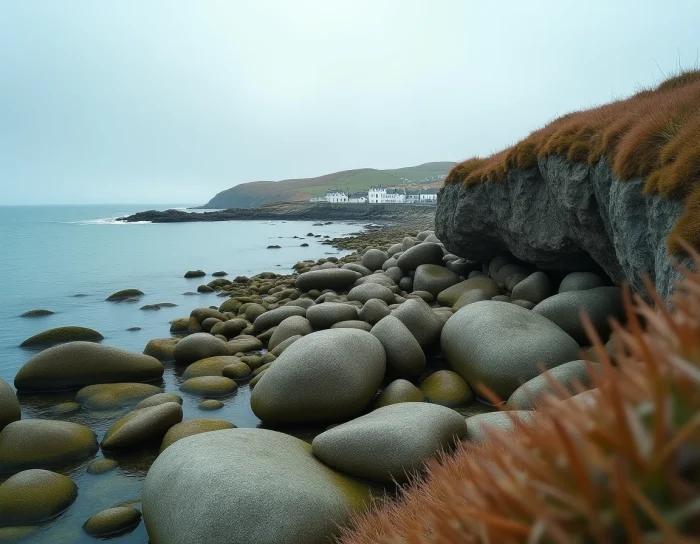
Brittany refers both to a French administrative region (four departments: Côtes-d’Armor, Finistère, Ille-et-Vilaine, Morbihan) and a larger historical territory that includes Loire-Atlantique. This distinction between administrative Brittany and historical Brittany still structures regional debates, cultural claims, and the way Bretons perceive their identity.
Breton languages and declining linguistic heritage
Two regional languages coexist in Brittany: Breton, a Celtic language historically spoken in the western half (Lower Brittany), and Gallo, a Romance language of the eastern half (Upper Brittany). Breton belongs to the same family as Welsh and Cornish, making it a rare linguistic case in mainland France.
The number of Breton speakers has significantly decreased over the twentieth century. Gallo, less publicized, remains even more fragile. Networks of bilingual schools (Diwan for immersion, Div Yezh in public, Dihun in private Catholic) maintain transmission, but generational renewal remains a structural challenge.
This linguistic situation distinguishes Brittany from most other French regions. Breton has a direct impact on toponymy, bilingual road signage, the names of municipalities, and cultural practices like kan ha diskan (call and response singing). To follow the various facets of regional news and culture, a useful resource is: https://www.portailbreton.net/, which aggregates content related to the territory.
Residential attractiveness in Brittany: a migratory balance that changes the game
INSEE analyses show that several Breton departments, notably Morbihan and Ille-et-Vilaine, are experiencing a population increase driven by positive migratory balance rather than natural balance. This phenomenon has accelerated since the health crisis of 2020.
The profiles of newcomers are varied: retirees attracted by the coast, remote workers for companies outside the region, families leaving metropolises where housing costs have become prohibitive. INSEE Brittany and DREAL have documented a strong increase in commuters and remote workers settled in Brittany while maintaining employment elsewhere.
Real estate pressure on the Breton coast
This attractiveness has a tangible downside. Along the coast, the rise of second homes and short-term rentals (tourist accommodations) reduces the stock available for permanent residents. Several coastal Breton municipalities have seen real estate prices increase to the point of pushing local workers inland.
Municipalities have begun to take measures, such as capping the number of tourist accommodations or creating zones reserved for primary residences. The issue has become a fully-fledged local political challenge, and some municipalities in Finistère or Morbihan have joined a movement comparable to what exists in the Basque Country.
Breton agriculture and environmental transition
Agriculture represents a regional economic pillar, with a historical specialization in livestock (pork, poultry, dairy cattle) and vegetable crops. Brittany concentrates a major share of French agri-food production.
This productive intensity has generated documented environmental tensions for several decades:
- Green tides, linked to agricultural nitrate surpluses that promote the proliferation of algae on certain beaches, remain a recurring problem despite successive combat plans
- Water quality (rivers, groundwater, coast) is subject to regular monitoring, with mixed results depending on the watersheds
- The Breton agri-food sector, long focused on volume and export, is beginning to diversify towards quality labels, short circuits, and lower-impact practices
The transition is not without its challenges. Breton farms are often of intermediate size, caught between high compliance costs and pressured selling prices. The renewal of agricultural generations will determine the direction this model takes in the coming decades.
Built heritage and Breton art: beyond clichés
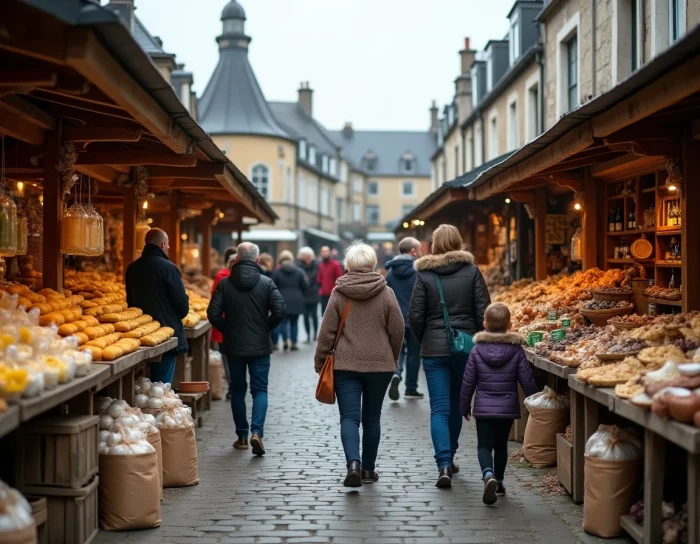
Brittany has a dense architectural heritage that far exceeds the alignments of Carnac or the ramparts of Saint-Malo, although these sites remain among the most visited. Religious architecture is a strong marker of the territory.
The paroisse enclosures, concentrated mainly in the north of Finistère, form a unique ensemble in Europe. Each enclosure combines a church, a sculpted calvary, an ossuary, and a triumphal arch within a closed space. Most of these ensembles date from the sixteenth and seventeenth centuries, a period of prosperity linked to the flax and hemp trade.
Contemporary Breton art and festivals
The Breton cultural scene relies on a network of festivals that functions as a true regional calendar. Les Vieilles Charrues in Carhaix, the Interceltic Festival of Lorient, or the Transmusicales of Rennes cover very different genres, from Celtic music to independent rock.
Breton music itself has experienced several waves of renewal. The movement initiated in the 1970s by artists like Alan Stivell has been followed by successive generations that blend traditional sounds (bombarde, biniou) with electronic or jazz influences. This cultural dynamism contributes to regional identity as much as built heritage.
- Rennes concentrates a large part of urban cultural life, with places like the Museum of Fine Arts and the National Theatre of Brittany
- Nantes, although located in Loire-Atlantique (thus outside the administrative region), is still claimed by some Bretons as the historical capital of the duchy
- Brest and Lorient animate the coast with large-scale maritime events
The question of the reunification of Brittany (the attachment of Loire-Atlantique to the administrative region) remains a recurring topic in local public debate. No institutional decision has been made, but opinion polls regularly show majority support in the five concerned departments. This debate illustrates how territory, culture, and identity remain intertwined in Brittany, well beyond administrative boundaries.